Saturday, May 1, 2010

7 Phenomenal Wonders of the Natural World


The classical natural wonders are huge and hard to miss – vast canyons, giant mountains and the like. Many of the most fantastic natural phenomena, however, are also least easy to spot. Some are incredibly rare while others are located in hard-to-reach parts of the planet. From moving rocks to mammatus clouds and red tides to fire rainbows, here are seven of the most spectacular phenomenal wonders of the natural world.


1) Sailing Stones


The mysterious moving stones of the packed-mud desert of Death Valley have been a center of scientific controversy for decades. Rocks weighing up to hundreds of pounds have been known to move up to hundreds of yards at a time. Some scientists have proposed that a combination of strong winds and surface ice account for these movements. However, this theory does not explain evidence of different rocks starting side by side and moving at different rates and in disparate directions. Moreover, the physics calculations do not fully support this theory as wind speeds of hundreds of miles per hour would be needed to move some of the stones.

2) Columnar Basalt

When a thick lava flow cools it contracts vertically but cracks perpendicular to its directional flow with remarkable geometric regularity – in most cases forming a regular grid of remarkable hexagonal extrusions that almost appear to be made by man. One of the most famous such examples is the Giant’s Causeway on the coast of Ireland (shown above) though the largest and most widely recognized would be Devil’s Tower in Wyoming. Basalt also forms different but equally fascinating ways when eruptions are exposed to air or water.


3) Blue Holes


Blue holes are giant and sudden drops in underwater elevation that get their name from the dark and foreboding blue tone they exhibit when viewed from above in relationship to surrounding waters. They can be hundreds of feet deep and while divers are able to explore some of them they are largely devoid of oxygen that would support sea life due to poor water circulation – leaving them eerily empty. Some blue holes, however, contain ancient fossil remains that have been discovered, preserved in their depths.


4) Red Tides


Red tides are also known as algal blooms – sudden influxes of massive amounts of colored single-cell algae that can convert entire areas of an ocean or beach into a blood red color. While some of these can be relatively harmless, others can be harbingers of deadly toxins that cause the deaths of fish, birds and marine mammals. In some cases, even humans have been harmed by red tides though no human exposure are known to have been fatal. While they can be fatal, the constituent phytoplankton in ride tides are not harmful in small numbers.


5) Ice Circles


While many see these apparently perfect ice circles as worthy of conspiracy theorizing, scientists generally accept that they are formed by eddies in the water that spin a sizable piece of ice in a circular motion. As a result of this rotation, other pieces of ice and flotsam wear relatively evenly at the edges of the ice until it slowly forms into an essentially ideal circle. Ice circles have been seen with diameters of over 500 feet and can also at times be found in clusters and groups at different sizes as shown above.


6) Mammatus Clouds

>


True to their ominous appearance, mammatus clouds are often harbingers of a coming storm or other extreme weather system. Typically composed primarily of ice, they can extend for hundreds of miles in each direction and individual formations can remain visibly static for ten to fifteen minutes at a time. While they may appear foreboding they are merely the messengers – appearing around, before or even after severe weather.


7) Fire Rainbows


A circumhorizontal fire rainbow arc occurs at a rare confluence of right time and right place for the sun and certain clouds. Crystals within the clouds refract light into the various visible waves of the spectrum but only if they are arrayed correctly relative to the ground below. Due to the rarity with which all of these events happen in conjunction with one another, there are relatively few remarkable photos of this phenomena.


Lovely Thoughts for Lovely People Just Like You

Wipe A Tear; Remove A Pain


Many feel that charity means donating money, clothes etc to the poor. No doubt this is charity, but even if we have wiped a single tear or removed a single pain - we have made a single being feel better and helped one person feel God’s Love – we have made a difference in the world.

If a man prays for his welfare, he is ordinary. If he prays for the welfare of others, he is extraordinary, but when he prays for the welfare of the whole world, he is divine. So, when we think more about others rather than of ourselves, God recognises us and looks after our own welfare. He says – “Who is this child of Mine who considers the good of others more important that his own? May he live a long and healthy life so that a greater number of souls can benefit from him.”

However, when good deeds are done to enhance one’s own self image, most of the good Karma drains away because the motive behind the action is selfish. God does not recognise such deeds. This is like drinking water from a tap without using a glass. When you cup your hands before a tap and drink from it directly, most of the water drains away and is wasted. When we don’t use the cup of benevolence to hold the water of charity, most of it drains away and is wasted. While performing charity, it is said that even the left hand should not know what the right hand is giving. Such should be the modest reticence of the giver.

When we begin to look for opportunities to perform service (seva), initially, we may calculate the expenditure that we incur when we engage ourselves in charitable activities. If we forget about this and just focus on the seva, things are automatically adjusted so that we can afford this expenditure and do not feel the pinch.

So, donating to the best of our ability is one aspect of charity, while the other aspect is giving a few moments of our time to those who need it. It may be lending an ear to those who are in trouble or a smile or a hug to the distressed. These acts are neither minor nor insignificant. In fact, these are the ‘small’ acts of kindness and compassion which we can practise everyday. We have been gifted with everything that we need, so is it not our duty to give at least a part of what we have got to those who are less privileged than we are?

Therefore, let us open our hearts with joy to pour forth God’s own divine love to the whole of creation


Lovely Thoughts for Lovely People Just Like You

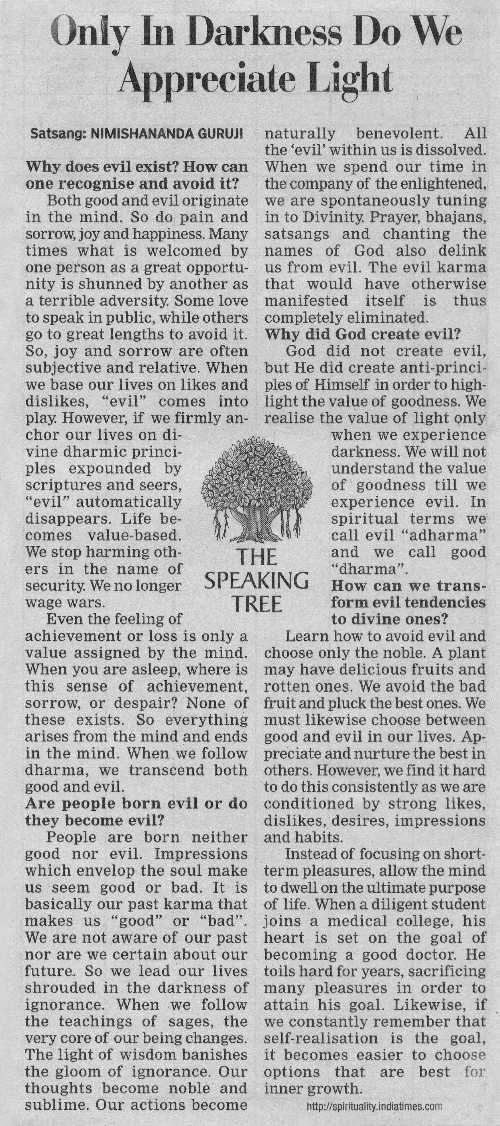
Only In Darkness Do We Appreciate Light


Why does evil exist? How can one recognise and avoid it?


Both good and evil originate in the mind. So do pain and sorrow, joy and happiness. Many times what is welcomed by one person as a great opportunity is shunned by another as a terrible adversity. Some love to speak in public, while others go to great lengths to avoid it. So, joy and sorrow are often subjective and relative. When we base our lives on likes and dislikes, “evil” comes into play. However, if we firmly anchor our lives on divine dharmic principles expounded by scriptures and seers, “evil” automatically disappears. Life becomes value-based. We stop harming others in the name of security. We no longer wage wars.


Even the feeling of achievement or loss is only a value assigned by the mind. When you are asleep, where is this sense of achievement, sorrow, or despair? None of these exists. So everything arises from the mind and ends in the mind. When we follow dharma, we transcend both good and evil.
Are people born evil or do they become evil?


People are born neither good nor evil. Impressions which envelop the soul make us seem good or bad. It is basically our past karma that makes us “good” or “bad”. We are not aware of our past nor are we certain about our future. So we lead our lives shrouded in the darkness of ignorance. When we follow the teachings of sages, the very core of our being changes. The light of wisdom banishes the gloom of ignorance. Our thoughts become noble and sublime. Our actions become naturally benevolent. All the ‘evil’ within us is dissolved. When we spend our time in the company of the enlightened, we are spontaneously tuning in to Divinity. Prayer, bhajans, satsangs and chanting the names of God also delink us from evil. The evil karma that would have otherwise manifested itself is thus completely eliminated.


Why did God create evil?


God did not create evil, but He did create anti-principles of Himself in order to highlight the value of goodness. We realise the value of light only when we experience darkness. We will not understand the value of goodness till we experience evil. In spiritual terms we call evil “adharma” and we call good “dharma”.


How can we trans form evil tendencies to divine ones?

Learn how to avoid evil and choose only the noble. A plant may have delicious fruits and rotten ones. We avoid the bad fruit and pluck the best ones. We must likewise choose between good and evil in our lives. Appreciate and nurture the best in others. However, we find it hard to do this consistently as we are conditioned by strong likes, dislikes, desires, impressions and habits.


Instead of focusing on shortterm pleasures, allow the mind to dwell on the ultimate purpose of life. When a diligent student joins a medical college, his heart is set on the goal of becoming a good doctor. He toils hard for years, sacrificing many pleasures in order to attain his goal. Likewise, if we constantly remember that self-realisation is the goal, it becomes easier to choose options that are best for inner growth.

Lovely Thoughts for Lovely People Just Like You

It can always be done


Seek and you will find ...

Aman invited Mulla Nasruddin to go hunting with him, but gave him a slow horse and kept the fast one for himself. He sped away and Nasruddin lagged behind. Soon it began to rain and the Mulla was alone. He took off all his clothes and then he sat down on the pile of clothing. Once the rain stopped, he wore the clothes again and reached his host's house for lunch. The host could not understand how he was wet while the Mulla was dry and asked him how this happened. Nasruddin answered, "It's because of the horse you gave me." The next day, the host gave the Mulla his fast horse and kept the slow one for himself. When it began raining, Nasruddin did the same thing and when the host met him, he was furious, because he was wet again and the Mulla was dry. He shouted, "It's all your fault. I got wet because you made me ride that terrible horse!"

So, often we are inclined to find fault with our workplace, our colleagues, friends, family and clients when the fault may in fact be with us. It may be that we have done nothing to look for the best solution for a certain problem. Instead, we might be preoccupied in blaming others for our own inability to make use of what is called 'horse sense'.

As the saying goes, 'It's not the horse that counts, it's the rider'. The rider makes a huge difference. There are plenty of rags-to-riches stories. However, most of these point to the fact that every time specific, but inevitable, challenges arise - and they always do - the rider, perhaps like a poor but enterprising man, comes up with innovative ways to overcome these challenges. There are those who, at the very hint of a challenge, might have thrown in the towel or changed tracks, fretted and fumed. But the man who chooses to handle his problems the way Mulla Nasruddin did - who found a way to remain dry even when faced with a downpour - always emerges triumphant, whether he rides a slow horse or a fast one. That is, regardless of whether he has the means or tools to surmount problems, and whether or not his circumstances are conducive or unfriendly, he does manage to find a way.

Often, we are so obsessed with our problems that we forget to look for ways to solve them. Anthony de Mello recounted the story of a man who had lived for many years with a sage and felt that he had gained no real wisdom during his time of tapasya. He asked the sage why he had failed to grasp the sage's wisdom. The sage replied, "When I point to the moon, you don't look at it; you keep staring at my finger. I am only the finger pointing to the moon, you cannot achieve realisation by looking at me or my finger!" Being distracted, looking at other issues, agonising over the past, regretting your actions or lamenting your destiny can lead to no progress; the only way forward is to take what you have at your disposal and do your best with it - without seeking out the 'villains' who put you in that hapless state. Whether the horse is slow or fast, the rider who weathers the storm has to be a Nasruddin. For that, you need to think out of the box and act swiftly.


Lovely Thoughts for Lovely People Just Like You
Sex, gift from god


Freedom from sex is not repression of sex; it is the understanding of sex. By understanding, one goes beyond it. But that does not mean that you will be angry, against it and antagonistic. You will be blissful. You will bless everybody with the hope that someday, they will also go beyond it.

Religion has to be rooted in the earth. It also has to rise towards the sun. It is like a lotus flower -- rooted in mud and rising towards the sun. The lotus has to be freed from the mud, but the mud has not to be condemned at all, because the mud is nourishment. Your sex energy is nourishment for your samadhi. It is out of the mud of sex that the lotus of samadhi is going to bloom. Never repress it! Never be against it; rather, go deep into it with great clarity, with great love. Go like an explorer. Search all the nooks and corners of your sexuality and you will be surprised and enriched and benefitted.

Knowing your sexuality, one day you will stumble upon your spirituality. Then you become free. Your energy has risen high. Now sex is just like a toy. But you are not angry with other people who are still playing with the toy. You will understand them, too, you will have compassion for them. You would like to help them go beyond, but you will not condemn them ... They are not doing anything wrong.

Sex is not a sin. Nobody is ever punished or sent to hell for sex. God has given it to you, you are born with it; you have not created it – like the atom bomb, bayonet, sword, money or politics -- these are inventions of the ugly human mind. These people will go to hell, certainly. But sex is a God-given gift, and it is a great seed. Once it starts sprouting and finds the right soil, it will become a big tree. Millions of flowers will come to it.

It is not only a child that is born out of sex; you will be reborn too! Sex is the very source of creativity. Out of sex new life is born. What can be more valuable than life? God has chosen sex as the vehicle for life. Life comes through sex, in sex, out of sex. And those who know, those who have gone beyond say that another life, spiritual life, also comes through it. You will become twice-born through it, you will resurrect out of it. It is life-giving energy.

Sex is sacred; it is the temple of God. Sex is potential spirituality. How can a seeker be disinterested in it? Yes, he has no personal interest in it. He has gone beyond it; but he is immensely interested. In fact for a man who is free from sex his interest becomes very great. Now, he is interested in everything.

When you are obsessed with sex ... you are not interested in poetry, music, beauty ... you are only interested in sex. And if sometimes you do show interest in these things it is only because some sexuality is there. That's why 99 per cent of art is sex-based, because 99 per cent of people don't want anything else. Films, novels, books -- even so-called religious books -- are all full of sexuality. Sometimes it is in the name of condemnation, but they go on talking about the physical, the sexual. Sometimes they are obscene. The man who is free of sex, his interest is also free of sex. His interest spreads to the whole of life.


Lovely Thoughts for Lovely People Just Like You

Life has much to offer, don't go away yet


A spate of suicides reported recently makes us wonder: What drives an individual to take his own life? The drastic action is perhaps due to intense despair and a feeling of helplessness.

The question then arises: What is life and what sustains it? No doubt the physical frame is sustained and supported by air, food and water. But at the psychological level it is hope, the perception of self-worth and moral strength that affirm the will to live. All excuses like loneliness, loss of wealth, humiliation, shame and guilt that might force the decision to give up on life midstream could be traced to the loss of the will to live.

Hope is the springboard of all activity. A new hour, a new dawn and a new year, all hold out hope. Hope can also spring forth in a manner that is unconnected with us. A good turn of events for someone else can kindle hope in us. However, hope could turn out to be a double-edged sword. Unfulfilled hope can be devastating, as in business, love and competitive situations. Grief might blur one’s vision but the flicker of hope helps us navigate the darkness of despair.

In contrast, death is total darkness. One way of handling this is to hope realistically rather than reach for something that is unattainable. There will be less chance, then, of falling so short of the goal that everything seems out of reach and hence, life will not lose all meaning. To act and not be distracted by the fruit of action is a good way to avoid such situations. The Gita advises us to remain detached from fruit of action.

Self-criticism and introspection are useful exercises to appraise one’s strengths and weaknesses so that one can understand one’s potential. This is not to sit in judgement and find fault. Any assessment of one’s worth can only be relative and so is not absolute. Comparisons are odious, wrote a poet. So when we desist from making comparisons, it helps us overcome a great many problems.

Everything in the world is there because it is of some worth. Ramakrishna Paramhansa said that a stone that lies on the road is there for a reason we might not be aware of. Every person likes to be loved, to receive compassion and kindness. No one would like to be hurt, deceived or offended in any way. So the universal moral code is clear: Do unto others what you would have them do to you. A convicted criminal appeals for mercy or clemency hoping that the very moral code he violated will somehow pull him out of the dire situation he has put himself in. In some cases a one-off moral transgression may make it difficult to justify the continuance of life.

Speaking a lie while being aware of the truth and doing wrong intentionally even while knowing what is right could lead to dilemmas that erode self-worth. A fractured mind, like a broken mirror, does not reflect reality. It leads to misconceptions and creates confusion, leading one to jump to conclusions. When one is unable to reconcile contradictions in perception, hasty decisions are made and when translated into action, these can have disastrous, and maybe irreversible consequences. Such as the decision to take one’s life.

A unified mind is the key to peace, happiness and fullness. It can help us see the whole picture rather then get trapped in ephemeral details. Not everyone might turn out to be a Beethoven or Stephen Hawking. However, by not getting disheartened by setbacks and by finding ways to overcome difficulties, we can learn to appreciate and enjoy whatever we have instead of calling it quits.


Lovely Thoughts for Lovely People Just Like You

Working with values


Professional life flowers best in situations where collaboration and partnership with others is the norm and where there is mutual trust and understanding.

However, when employees are driven to deliver results on the basis of unhealthy comparisons, there is trouble. When the Bhagavad Gita speaks of the need for action and remaining detached from the fruits of one’s action, it is saying what our elders often repeat to us: To work with detachment.

Sometimes, hierarchy can help smooth the flow of development. An atmosphere of mutual trust and give and take can ensure that participation is democratic. There are spiritual models of functioning based on hierarchy that do promote spiritual growth. There are, however, also holistic models that are more flexible and that ensure a two-way flow, where every aspect of our lives – physical, psychological, emotional and social – is integrated.

This model requires participants to have spiritual and emotional maturity. A head honcho would combine intellectual prowess with compassion and kindness and enforce discipline without stepping on toes. The strengths of each individual would be tapped and together a family of employees is created, anchored to eternal values.

A value-driven organisation has a different mindset. The open way of functioning ensures that each individual is valued for what he can contribute. No unfavourable comparisons are made. If at all, comparison is only meant to create a higher benchmark and so is aspirational.

Too much emphasis on academia and brilliance and on rewarding results has sometimes given rise to lopsided priorities. What often get rewarded is superficial success, and not long-term commitment and loyalty to the organisation or mission.

The business world is changing. Management practices are now increasingly including a spiritual perspective. There is so much more listening than talking. There is a greater sense of cooperation and collaboration in a spiritually empowered marketplace.

Although the younger generation is much more market savvy than the previous generation, they do require spiritual inputs to cater holistically to changing environments and values. The words love, acceptance and transformation are back in circulation in the workplace, thereby giving less room for authoritarianism.

New Age spiritual teachers are faced with the task of conveying in contemporary easy-to-understand terms the priceless messages contained in sacred texts of yore that explain eternal values, so important for right thinking and living, whether at home or at the workplace. There is an effort to find what unites rather than divides. The quest for eternal values like love, peace, joy and fulfillment are being given fresh lease of life.

In the pursuit of holistic development of employer and employee, a professional worker is required to be not just excellent in his job but also display evolved qualities that make him less militant and more cooperative, less of a complainer and more of a doer. The more the employee is engaged in service of others, the less he tends to focus on selfish motivations and ends that might sometimes egg him to veer off the straight path. And service thus rendered with a positive and wholehearted approach can only add to common benefit.

Definitely, there is a place for professional excellence in your working life. But that has to include also spiritual progress that will get reflected in the quality of work you do as well as in the manner in which you relate to others in the workplace and outside.


Lovely Thoughts for Lovely People Just Like You
Related Posts Plugin for WordPress, Blogger...
Related Posts with Thumbnails